Yesterday we gave a school-wide test to many of our high school students. It was part of a monthly, statewide voluntary "fun" competition called the Florida Math League. There are always six questions and they range from pretty simple to pretty tough. Perfect scores are rare. My calculus students usually average about 3 correct, although there is no calculus on the test.
One question caught my eye. Many, many of our bright students got it wrong, but it's a common type of word problem. What do you think? Would you get this one right?
In a 10-km race, First Runner beat second runner by 2 km, and First Runner beat Third Runner by 4 km. If all 3 runners always ran at constant rates, by how many km did Second Runner beat Third Runner.
The answer will be posted below in the comments. If you're a math teacher teaching Algebra II or above, ask your own students and let me know how well they do.
Why do you think so many people get this kind of problem wrong?
Photo Credit
Wednesday, January 15, 2014
Tuesday, January 14, 2014
what if you're doing it wrong?
I've always hated "list" posts. They tell you the 5 best of this or the 8 worst of that. They often claim to solve problems from how to lose weight to how to save a marriage to how to ask for a raise. I usually find they over-simplify or generalize to the point of being useless.
With that rather negative introduction, I ask you to consider the following post, Six of the best: the traits your child needs to succeed.
What I really want to know is what you think about the very idea of fostering traits in children. Do you think it is even possible to "build" a child with these traits? What role do parents and schools play in creating these "super" children?
It's not that I don't think there's a level of responsibility inherent in teaching or in parenting. There is tremendous responsibility in both jobs and the article is happy to list those things parents believe are the schools' and teachers' jobs, items like "well-run lessons, skilled teachers, a creative curriculum, high expectations." But as I watch parents beat themselves up because they're too tired to make every meal perfectly nutritious and teachers give up in despair because their students can't pass the state exams, I think we need to ask ourselves if articles like this aren't really just a set up.
Do parents (and teachers) really have the ability to create kids that possess joie de vivre, resilience, self-discipline, honesty, courage, and kindness? Are there really parents (or teachers) out there actively discouraging these traits?
If we are to believe articles like this and take a look at the children of the world, we are forced to come to the conclusion that most kids do not have all these traits. And if your own children, wonderful as they are, are among those that do not exhibit these traits, then this means that someone, everyone, or perhaps just you, are doing "it" wrong.
With that rather negative introduction, I ask you to consider the following post, Six of the best: the traits your child needs to succeed.
In it the author proceeds to list and describe the six qualities that children need to be successful in school.
1. Joie de vivre
2. Resilience
3. Self-discipline
4. Honesty
5. Courage
6. Kindness
Hillary Wilce concludes the post with the following:
"Our children badly need us to help them develop stronger, more flexible backbones, and all the qualities that contribute to a strong inner core can be actively fostered and encouraged by parents (parents and schools working together is even better). Just as muscles grow stronger with regular exercise, so character traits are strengthened by thoughtful encouragement and reinforcement."
I'm trying to set aside the fact that there is no discussion of the relationship that these traits have with success in school. Do these traits cause kids to be successful? Does success in school provide the exercise to strengthen these traits? Or do these traits and success in school happen together, both enhanced by any number of additional, unexplored factors ranging from genetics to family income to who knows what?
What I really want to know is what you think about the very idea of fostering traits in children. Do you think it is even possible to "build" a child with these traits? What role do parents and schools play in creating these "super" children?
I ask because as a parent of two sons who could not be more different, I have to wonder what I did that made them so. As a teacher of literally thousands of students whose accomplishments range from incredible success to dismal failure, I have to ask what I and their parents did to foster the disparate range of traits that resulted.
It's not that I don't think there's a level of responsibility inherent in teaching or in parenting. There is tremendous responsibility in both jobs and the article is happy to list those things parents believe are the schools' and teachers' jobs, items like "well-run lessons, skilled teachers, a creative curriculum, high expectations." But as I watch parents beat themselves up because they're too tired to make every meal perfectly nutritious and teachers give up in despair because their students can't pass the state exams, I think we need to ask ourselves if articles like this aren't really just a set up.
Do parents (and teachers) really have the ability to create kids that possess joie de vivre, resilience, self-discipline, honesty, courage, and kindness? Are there really parents (or teachers) out there actively discouraging these traits?
If we are to believe articles like this and take a look at the children of the world, we are forced to come to the conclusion that most kids do not have all these traits. And if your own children, wonderful as they are, are among those that do not exhibit these traits, then this means that someone, everyone, or perhaps just you, are doing "it" wrong.
Monday, January 13, 2014
the final countdown
Senioritis: A crippling disease that strikes high school seniors. Symptoms include: laziness, an over-excessive wearing of track pants, old athletic shirts, sweatpants, athletic shorts, and sweatshirts. Also features a lack of studying, repeated absences, and a generally dismissive attitude. The only known cure is a phenomenon known as Graduation. ~Urban Dictionary
My seniors come back from Christmas break wishing it was over. They hear from colleges and start to make plans for the rest of their lives, lives that rarely include high school. They need it to end.
I plan to keep going. I will teach every day, assign homework, give tests and quizzes, create projects and novel activities. What the seniors do does not change my plans or my attitude. They will not turn in homework sometimes. They will do poorly on tests and quizzes. Their grades will drop. I will try to encourage them and attempt to remind them that it's the finish that counts. Some will hear me. Some will ignore me. I do not control the behavior of others.
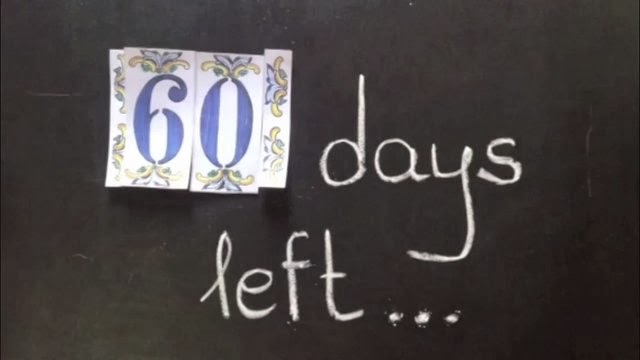
We are on a modified block schedule, and I have about 60 days of classes left with my seniors. That's 60 days to teach them about math and about life. There's 60 days to enjoy their company and their teenagerness. On any given day I'm never sure if they will laugh or cry.
60 days is an eternity for my seniors, but for me, it's not enough. These days will crawl in their minds and fly by in mine. They can't wait to be gone. I long for them to stay.
I always tell them it's not over until I say it's over. It's not over yet. But it is the final countdown.
My seniors come back from Christmas break wishing it was over. They hear from colleges and start to make plans for the rest of their lives, lives that rarely include high school. They need it to end.
As a teacher I used to wear myself out letting the seniors' attitudes drive me crazy. But now in my later years, I've come to know it's not about me. Second semester doesn't signify the end of anything for me. I plan to be back next year. After 27 years of teaching, this is just another semester.
I plan to keep going. I will teach every day, assign homework, give tests and quizzes, create projects and novel activities. What the seniors do does not change my plans or my attitude. They will not turn in homework sometimes. They will do poorly on tests and quizzes. Their grades will drop. I will try to encourage them and attempt to remind them that it's the finish that counts. Some will hear me. Some will ignore me. I do not control the behavior of others.
We are on a modified block schedule, and I have about 60 days of classes left with my seniors. That's 60 days to teach them about math and about life. There's 60 days to enjoy their company and their teenagerness. On any given day I'm never sure if they will laugh or cry.
60 days is an eternity for my seniors, but for me, it's not enough. These days will crawl in their minds and fly by in mine. They can't wait to be gone. I long for them to stay.
I always tell them it's not over until I say it's over. It's not over yet. But it is the final countdown.
Friday, January 10, 2014
welcome home
Wednesday was an exceptionally busy day for our school. In addition to the visiting a cappella group, the Yale Alley Cats, the city of Winter Park put on a parade for one our alums, Charles Nadd. A member of the Trinity Prep class of 2007, Chuck attended West Point '11 and now, at age 24, is a helicopter pilot. His positive, can-do attitude was evident when he was in high school, and we all knew he was going places. He is not our first alum to serve overseas, but his safe return from Afghanistan and continuous zest for life make us so proud. As Chuck would say, "Life is Beautiful." Photo Credit: Ashley Johnston
Video Credit
Thursday, January 9, 2014
no accompaniment required
On Wednesday we were treated to a concert from the Yale Alley Cats. Yearly visits from an a cappella group are definitely a favorite at our school, and sometimes they even feature an alum, a special treat. You can listen to a song from this fantastically talented group here. Enjoy!
Find out more about the Yale Alley Cats here.
Wednesday, January 8, 2014
snow days
So it got cold in Orlando, a brisk 35 degrees on Tuesday morning. Then we all blinked, and it was mostly over. It'll be 80 degrees by Friday. But my friends up north were not so lucky. As the temperatures dropped below zero with dangerously cold wind chills, schools all over the north and even those as far south as Atlanta closed their doors. This wasn't a just a snow day, although there was plenty of snow. Millions of parents sighed in dismay as snow days turned their homes into prisons.
You'd think snow days would be awesome, but most of these kids have been home for two or more weeks. With the excitement of Christmas and New Year's over, these snow days stunk. Kids were bored. It's tough to entertain 7-year old Sally for days on end when she's trapped inside. She needs exercise and interaction with other kids, something that's not possible when you're snowed in and it's literally too cold to play outside. Tough too, occupying her brother, 9-year-old Billy, a child not so excited about reading or doing puzzles. He'd much rather fight with his sister, watch cartoons, or play video games for hours on end, much to his mother's dismay.
The cold will end and all the children will head back to school. A collective and silent parental cheer of relief will erupt nationwide. But school is not always such a great place for kids. Teachers across the country will embrace these restless little souls, not just one or two at a time, but in packs of thirty, all confined to a twenty by twenty foot room. You'd think there'd be science experiments and games, theatre performances complete with costumes and learning as play. Study after study has shown us this is how to best teach kids, but we no longer have time to do these things Instead we continually cut back on rich experiences in favor of more and more seat work. The richness is confined to "specials" like physical education, computers, art, or music a couple times a week. We all know that kids only have pent up energy on Mondays and Thursdays right before lunch. Their musical and artistic creativity can be adequately expressed from 9:30-10:00 on alternate Wednesdays. And frankly, what's the point of teaching them about computers. In twenty years we'll all have a chip in our heads anyway.
This is the modern school. Children are forced to sit too quietly for hours on end, preparing for standardized tests and five-paragraph essays. There will be plenty of math worksheets but little physical release. There's always another spelling test but no money or time for music, for art, for beauty. And teachers will do the job of somehow entertaining and educating these children, a job that many parents are tired of doing after a week or two.
Teachers do their best, but let's all be honest. The only thing that matters is the standardized test. The test is the measure the student, the teacher, and the school. Unfortunately that means that for a lot of kids, once they get to school, every day is a really bad, totally boring snow day.
Photo Credit
You'd think snow days would be awesome, but most of these kids have been home for two or more weeks. With the excitement of Christmas and New Year's over, these snow days stunk. Kids were bored. It's tough to entertain 7-year old Sally for days on end when she's trapped inside. She needs exercise and interaction with other kids, something that's not possible when you're snowed in and it's literally too cold to play outside. Tough too, occupying her brother, 9-year-old Billy, a child not so excited about reading or doing puzzles. He'd much rather fight with his sister, watch cartoons, or play video games for hours on end, much to his mother's dismay.
The cold will end and all the children will head back to school. A collective and silent parental cheer of relief will erupt nationwide. But school is not always such a great place for kids. Teachers across the country will embrace these restless little souls, not just one or two at a time, but in packs of thirty, all confined to a twenty by twenty foot room. You'd think there'd be science experiments and games, theatre performances complete with costumes and learning as play. Study after study has shown us this is how to best teach kids, but we no longer have time to do these things Instead we continually cut back on rich experiences in favor of more and more seat work. The richness is confined to "specials" like physical education, computers, art, or music a couple times a week. We all know that kids only have pent up energy on Mondays and Thursdays right before lunch. Their musical and artistic creativity can be adequately expressed from 9:30-10:00 on alternate Wednesdays. And frankly, what's the point of teaching them about computers. In twenty years we'll all have a chip in our heads anyway.
This is the modern school. Children are forced to sit too quietly for hours on end, preparing for standardized tests and five-paragraph essays. There will be plenty of math worksheets but little physical release. There's always another spelling test but no money or time for music, for art, for beauty. And teachers will do the job of somehow entertaining and educating these children, a job that many parents are tired of doing after a week or two.
Teachers do their best, but let's all be honest. The only thing that matters is the standardized test. The test is the measure the student, the teacher, and the school. Unfortunately that means that for a lot of kids, once they get to school, every day is a really bad, totally boring snow day.
Photo Credit
Tuesday, January 7, 2014
a hard look at the SAT
This weekend I was working with one of my own children on SAT questions. We were looking at questions he had either missed or omitted. I offer a pair of such questions for your consideration.
Chose the word or set of words that, when inserted in the sentence, best fits the meaning of the sentence as a whole.
The director's __________ anything outside the cocooned world of her film's protagonist is evident in the __________ of the few stilted scenes depicting unrelated events in the lives of other characters.
a) apathy toward ... raptness
b) infatuation with ... timorousness
c) veneration of ... adroitness
d) impatience with ... desultoriness
e) honesty about ... disingenuousness
Solve the problem and choose the correct answer.
If j is a positive integer and the remainder when j is divided by 11 is 5, what is the remainder when 3j+2 is divided by 11?
a) 3
b) 5
c) 6
d) 8
e) 9
So I have some questions about these two examples, both rated "hard" by the SAT folks.
Genuine discussion requested here...
(I know many of you are wont to wander back over to my Facebook page to discuss, but I am hoping you'll do it here. I've made commenting easier at this site, and you can even be anonymous if you like.)
P.S. The answers to the above questions are d and c.
Photo Credit
Chose the word or set of words that, when inserted in the sentence, best fits the meaning of the sentence as a whole.
The director's __________ anything outside the cocooned world of her film's protagonist is evident in the __________ of the few stilted scenes depicting unrelated events in the lives of other characters.
a) apathy toward ... raptness
b) infatuation with ... timorousness
c) veneration of ... adroitness
d) impatience with ... desultoriness
e) honesty about ... disingenuousness
Solve the problem and choose the correct answer.
If j is a positive integer and the remainder when j is divided by 11 is 5, what is the remainder when 3j+2 is divided by 11?
a) 3
b) 5
c) 6
d) 8
e) 9
So I have some questions about these two examples, both rated "hard" by the SAT folks.
- Which question was harder for you?
- What is the purpose of each question in the context of English or math?
- What does the ability to answer either of these questions tell you about a person?
- Would the ability to answer these questions help you be more successful in college? If so, how?
Genuine discussion requested here...
(I know many of you are wont to wander back over to my Facebook page to discuss, but I am hoping you'll do it here. I've made commenting easier at this site, and you can even be anonymous if you like.)
P.S. The answers to the above questions are d and c.
Photo Credit
Subscribe to:
Posts (Atom)