Thursday, March 13, 2014

3.14 reasons for leadership

I am the sponsor of our school's Mu Alpha Theta chapter and each year we elect officers to do the work of spreading the word that math is cool!  I am proud of our chapter.  The members spend hundreds of hours tutoring their classmates and participating in monthly competitions.  The capstone event is our yearly celebration of PI Day, a schoolwide event where pie is provided and all our students learn a little about PI. 

This year the officer in charge of the event got sick and the remaining officers got an important lesson in leadership.  As we all stood around at 7:15am staring at 66 pies, it was clear that the person who knew how many pies needed to be delivered to each classroom was in fact home in bed. 

It was a mad scramble, but eventually the pies were delivered and the students sprinted off to their first period class.  What I love about this event is not that it was chaotic, but that it was a great opportunity for the rest of the officers to see what happens when leadership is not present.  They had to step up and make a new plan to get the work done.  It wasn't pretty, but it worked, and I know these students learned an important lesson, not about math, but about life.

I want to remind all of my adult friends, teachers and parents, that giving kids a chance to lead, fall down, and pick themselves up is a vital part of the school experience.  Of course we adults can do things better, but that's only because we're more experienced.  Someone gave us a chance to plan something.   Maybe it didn't go perfectly, but we learned.

PI Day is actually Friday, March 14, but we do not have school.  Thus I wish you happy PI Day and hope you enjoy a piece of pie.

We begin Spring Break on Friday as well so I will be off line for the next week.  I hope to finish grading and write some comments, plan the rest of this school year, get some rest, and eat a slice of pie... maybe two.

Photo Credit
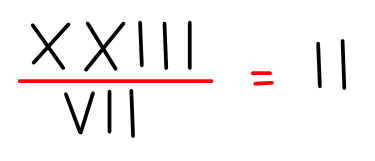

Here's a quick little PI Day puzzler for your students courtesy of Click and Clack at Car Talk and my colleague Bill Personette. 

13 matchsticks are arranged to form the Roman numeral equation 23/7 = 2.  This is obviously wrong.  Move one of the matchsticks to make the equation "correct."  (No fair moving the division bar or the equal sign. )

Wednesday, March 12, 2014

why you should care about Rick Roach

Photo Credit
Long-standing Orange County School Board member Rick Roach has decided not to run for a 5th term.  This may surprise people, as he has been a passionate and vocal member of this board for 16 years.  He came to the fore when he took and failed the FCAT in 2011, becoming an outspoken critic of the drive for testing that currently consumes the state.  He has decided to run for Commissioner of Education in Florida and is considered an unlikely candidate given his opposition to the FCAT's use for student and teacher evaluations.  I post his open letter here from the Washington Post in the hopes that someone, somewhere in Tallahassee might actually listen to teachers and consider a new path to educational excellence. 

I won’t seek a 5th term on the Orange County School Board
My many years as an Orange County’ School Board member representing District 3 have been rewarding beyond description. What I’ve learned, my friendships with students, teachers, administrators, constituents, members of civic and business organizations and fellow board members, the satisfactions of problems solved—even wrestling with problems that have no good solution—have unquestionably changed me for the better.
But I’m leaving in November, and I want to say why. I’m not leaving because I feel I can no longer make a difference in Orange County, but because I want to make a bigger difference than my role allows.
First, after 42 years as an educator and 16 as a school board member, I no longer recognize my profession. People who have never taught, or have been out of the classroom too long to remember teaching’s complexity, now control the institution. Education policy makers, who wouldn’t dream of telling surgeons how to wield a scalpel or telling pilots how to land an airliner, seem perfectly comfortable dictating rigid guidelines for teachers.
Second, the push to standardize has gotten out of control. As the world’s problems grow increasingly complex, we don’t need standardized minds but fresh thinking. We’ve long led the world in creativity and ingenuity, but those now running  the education show in Washington and Tallahassee have steadily taken away the trust, freedom and respect  that once allowed teachers to use their strengths effectively. I want to use my knowledge and experience to help solve these problems.
Finally, it’s the drive to test, test, and re-test that leads me to conclude that it’s time for me to do more to change this agenda.  That a score on a single, machine-scored, multiple-choice test can erase 180 days of work and override teacher judgment is insulting. Test manufacturers say, in print, that no single measure is accurate enough to base life-changing decisions on it, but their warnings are ignored, as is the fact that failure rates are set even before the tests are administered.
We’re so caught up in the testing frenzy, we even insist on testing kids with severe brain impairments, or who have little or no brain at all.  Immigrant children who arrive in America speaking no English are tested after only one year, when research clearly says it takes at least four or five years to become proficient in a new language. Pass-fail cut scores ignore margins-of-error, forcing kids to repeat a class for a full year because they missed the cut by a point or two. This has to end.
It has been my pleasure to serve you for the past 16 years and I want to continue to be your voice and search for common sense solutions, always putting our students first. My passion for real education tells me to get closer to the battlefield where decisions are being made. There are better ways to educate than we’re using and I want to find and promote them.
Yours in Education,
Judge “Rick”Roach

Monday, March 10, 2014

second opinion, please

I'm trying to decide if I'm a Madame Benevolent Dictator looking out for my students' health and well-being or a permanent Princess Crankypants.  As you know, I can be cranky at times, but I'd like to think I'm basically good.  Here's your chance to give me a grade. 

There's this group of 9th graders that plant themselves in the hallway of my building during lunch.  They talk about teenager stuff and they're not bad kids, but they are loud.  Monday I threw them out the door on the grounds that it was a beautiful day and they were loud enough for me to hear them 3 doors down.  I have no doubt I know what they think of me, but I'd like a second opinion. 

Benevolent Dictator or Princess Crankypants...  What do you think? 

of fishes and wishes...


When I was a kid, my mom used to say, "If wishes were fishes, we would all live in the sea," every time I expressed my longing for a ridiculous toy, dessert, or opportunity.  I think this is a pretty common practice, as it is important for children to hear the word "no" sometimes. 

A few years a ago representative from the Orlando Magic came to our school and offered students a pair of free tickets to a game if they would share their dreams for the future.  Some of our students could not even tell us their dreams.  As a result, in my leadership class I assign students the task of looking to the future and vocalizing their dreams.  I think this is an important activity.  By vocalizing our dreams, we can begin the conversation of why and how that can actually lead to dream fulfillment and success. 

Dreams don't just happen, they are built through hard work and sacrifice, hearing the word "no" and trying again, believing in the dream's value and the inherent value in the self.  Dreams are incredibly important and so I am asking you to share your ideas, to build a dream with me...

If you had one wish for education, one dream for your child, for your school, for teachers, for education, what would it be?

Will you share your dream in the comments?  If you could have one wish, one swim in the sea, what would it be? 

P.S.  My childhood dream was to be secretary of education.
My current wish is to get politicians out of education.

Your turn! 


Wednesday, March 5, 2014

can 5-year-olds learn calculus?

You can check out this book by Maria Droujkova here
I stumbled on this article from The Atlantic over the weekend, and I have really been giving it some thought.  Take a couple minutes if you like and read it here, or you can just read my summary below.  

Some summary points:

  • The way we teach math is contrary to the way the human brain, children, or mathematics works.
  • Early emphasis on arithmetic is bad for kids and can lead to negative attitudes about math.
  • The complexity of an idea and the difficulty of doing it are different.  An idea can be simple to understand but difficult to do.  
  • Games and free play are efficient means by which children learn.
  • By exposing children to the ideas of calculus and algebra early you build a "canopy of high abstraction that does not whither."
  • There are levels of understanding and there is no expectation that children will have a formal understanding of the mathematics early on.
  • Children need a voice in their learning and the ability to choose what and how they learn. 
  • Push back to these ideas comes from two camps. The first are those that think parents will push their kids too hard when they find out that they can "do calculus" in elementary school.  The second group thinks that essential computational skills will be lost.  
I have been teaching AP Calculus AB for more than 20 years and there is very little about this curriculum that I have not mastered at this point.  I have a clear understanding of the large questions that are answerable through the use of calculus and the details required to reason to a correct solution to such questions.  

I think that I have some real questions about the practice of leading children to calculus suggested by Maria Droujkova.  Some of it comes from the fact that for the past twenty years, my most successful calculus students were those that had completely mastered the foundational arithmetic skills required in support of the calculus.  I can certainly have a conversation about fractals and even wander into the ideas of infinitesimals with a 1st grader, but there is literally no chance that anything will come of that conversation other than, "This is cool."  Even if this child was taught some kind of procedural steps that led to a solution to a question they asked, I am sure they would not have any understanding of why the did any of the steps or what any of it meant.

One of the hardest things I have to do is teach my students how to see the forest for the trees.  Every day we look at the toolbox that is calculus and discover the amazing problem solving tools that allow us to solve both practical problems of changing quantities and growing volumes, but also to logically prove why a particular formula from geometry or technique from algebra actually works.  In many ways I feel like calculus is a culmination of a dozen years of mathematics, giving students the means to literally fly above the trees of questions and see the connections, the intertwining branches of the entire forest.  

So perhaps this really comes down to a matter of semantics.  What does it mean to teach a 5-year-old calculus?  What does it mean to teach the same subject to a high school student?  It's simply not the same thing.  And in my mind, that's ok.  Showing a 5-year-old that math is cool is absolutely fine with me.  Please, go ahead and spark curiosity!  Show kids fractals, wow them with infinity, expose them to the reasons why we want and need mathematical knowledge.  

But while they're building towers with Legos and creating origami snowflakes, don't forget to teach them to make change, calculate a tip, and choose a cell phone plan.  We need those skills too, maybe even more.  

Tuesday, March 4, 2014

see now I'm just mad

Yesterday I had a massive computer meltdown and I know it's supposed to be TEDTuesday, but I have been thinking about this post all weekend and I've decided I really need to say something, but before I do, let me tell you a story.

Consider Mary.  Mary enrolled in Weight Watchers.  Every week she went to a meeting and weighed in.  One week she went in and did really well.  She lost 5 pounds!  Everyone gave her high fives.  She even won the weekly award for the group!  Woo hoo!  The next week she weighed in, but she only lost 2 pounds.  Now 2 pounds is still awesome, but it was not as good as the previous week so the group ridiculed her.  It turns out that they expected her to lose more and more weight every week.  It didn't take Mary long to quit the group.

Am I crazy or does this seem silly?  It doesn't make sense to ask people to continally lose more and more weight.  It also makes no sense to ridicule her efforts,.  Most people respond pretty poorly to ridicule.   If Mary were on The Biggest Loser, I might think about this scenario differently, but this is not a game show and no Weight Watchers program would ever do such a thing.

Now consider Simone Ryals.  In 2012 she was a state finalist for a Presidential Award for Excellence in Mathematics and Science Teaching Program.  Her students did exceptionally well in science, many earning top scores, 5's on the State Science exam, an exam that has a 40% passing rate. 

But this year the state raised the standards on the test so that students must score even higher to earn a 5.  This I understand.  States are in the business of slowly raising standards, of pushing kids further and further in the hopes that we can get American education back on track.  Simone's students still did well, but they did not score as highly on the State Science exam.  Her students earned more 4s and 5s that were not quite as high. 

What yanks my chain is that Simone's students' lower scores mean that she is now ranked as an inferior teacher.  Despite the fact that her students still more than passed the exam that 60% failed, she is inferior.  And worse, her name will be published in the local papers so that parents will know which teachers are "great" and those that are "inferior."

Look, I get it.  We are all trying to improve education.  Parents want information and test scores may seem like a good way to measure a teacher's effectivness.  But it's not that simple and anyone with a lick of sense knows that we need teachers like Simone Ryals.  We can continue to measure a teacher's effectiveness by a single test score, to force teachers to work in a rigged system, or we can do better and create a system that is fair and helps all teachers and students improve.  Our kids deserve it.  Simone Ryals deserves it.  Anyone who disagrees should feel free to become a 5th grade science teacher.  If we don't change the system, we're going to need them.

Photo Credit